TDS for YouTubers in India: A Complete 2026 Guide
Heads up: some links below are affiliate. Using them helps us keep the blog free. We only recommend tools we’ve actually used or trust.
If you’ve ever received a brand-deal payment that looked smaller than what was quoted, you’ve already met TDS. Tax Deducted at Source is the system the Indian government uses to collect income tax in advance — the brand (or platform) holds back a percentage and deposits it against your PAN before the rest reaches your bank.
This guide covers the three places TDS shows up for Indian YouTubers and creators — brand deals, AdSense, affiliate income — and exactly how to get it back at tax-filing time.
See it work: TDS tracking from a ₹50,000 brand deal to ITR claim
3-minute walkthrough — the TDS Tracker section starts at 1:05. Watch the section-194J 10% deduction get computed live, why Form 16A reconciliation matters, and how your FY-wise claimable total surfaces as a single number ready for your CA.
Quick summary
| Income source | Who deducts | Section | Rate |
|---|---|---|---|
| Brand deal (sponsored video, paid integration) | The brand | 194J | 10% |
| Affiliate / commission income | Brand or platform | 194H | 5% |
| Video production work-for-hire | Client | 194C | 1% (individual) / 2% (firm) |
| AdSense revenue | Google (foreign) | — | 0% (no TDS) |
| Instagram/Meta creator payouts | Meta (foreign) | — | 0% (no TDS) |
Two takeaways from the table: brand deals always hit 10% TDS, and platform payouts (AdSense, Meta) do not. The “missing” tax on platform payouts doesn’t disappear — you owe it directly via advance tax, which is the part most new creators miss.
What is TDS, in one sentence?
TDS is income tax paid in advance, on your behalf, by whoever is paying you. The brand isn’t keeping the money — they deposit it with the Income Tax Department, tagged to your PAN. At tax filing time, the amount shows up on your Form 26AS / AIS and you claim it as a credit against your total tax liability. If your total tax owed is less than the TDS already paid, you get a refund.
TDS on brand deals — the 10% you’ve probably already seen
When a brand pays a YouTuber for a sponsored video, an Instagram reel, a product placement, or any kind of paid promotion, the income tax department treats it as professional services under Section 194J of the Income Tax Act. The brand must:
flowchart LR; A[Brand Deal] -->|10% TDS| B[TDS Deduction]; B -->|Deposit to Govt| C[Form 16A]; C -->|Claim at ITR| D[Refund]
- Deduct 10% TDS before paying you.
- Deposit the deducted amount to the government within 7 days of the following month.
- Issue you a Form 16A (TDS certificate) every quarter.
Worked example — ₹50,000 brand deal
You quote ₹50,000 for a sponsored Instagram reel. The brand:
- Gross deal value: ₹50,000
- GST 18% (if you’re GST-registered and invoicing): +₹9,000 → invoice total ₹59,000
- TDS 10% on the base of ₹50,000: −₹5,000
- Net received in your bank: ₹54,000 (= ₹59,000 − ₹5,000)
That ₹5,000 isn’t gone. It’s sitting against your PAN with the government. At ITR time, you’ll see it in Form 26AS and claim it back.
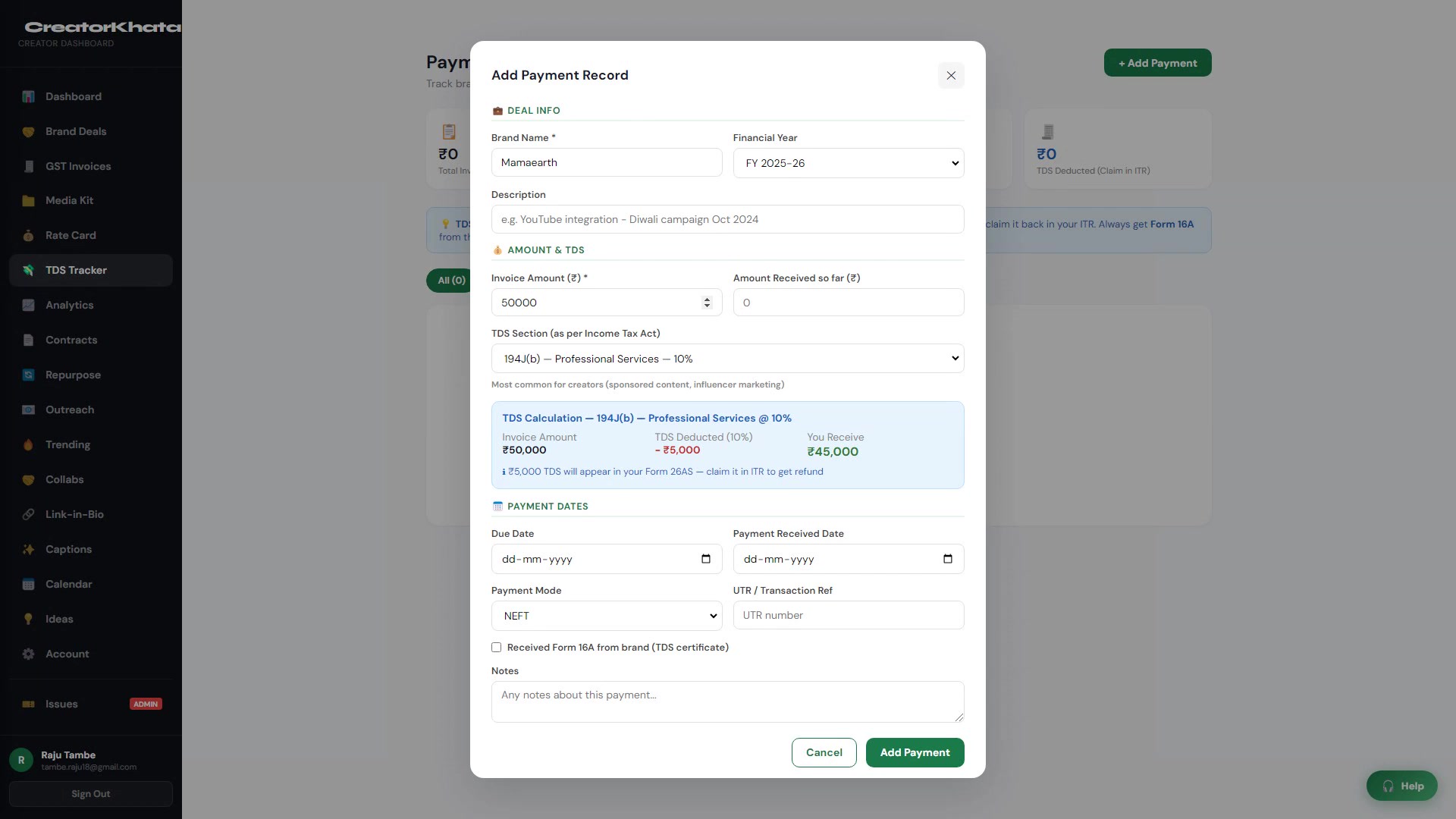
The TDS Tracker computes the deduction live as you enter the invoice amount — pick the section (194J / 194H / 194C / 192 / 195 — all 20+ sections covered), and the “You Receive” figure matches what should land in your bank.
Why 10% and not on the GST? TDS under 194J is calculated on the service value before GST. The brand should never deduct TDS on the GST portion. If your invoice doesn’t separate them cleanly, the brand’s accounts team will sometimes deduct on the total — which is wrong, and you’ll have to argue for a credit note.
When the brand doesn’t deduct TDS
For small one-off deals, some brands skip TDS. Two cases where they’re actually allowed to:
- Total annual payment to you from that one brand is under ₹30,000. Section 194J kicks in only above this threshold for any single payee. Below it, no TDS is required.
- You’ve given them a Form 15G/15H (rare for creators — you’d have to certify your annual income is below the taxable limit).
If your annual income from that brand is going to cross ₹30,000, the first invoice still gets TDS-deducted — they’re supposed to apply it from the start once they know the relationship will exceed the threshold.
TDS on affiliate / commission income — Section 194H, 5%
If a brand pays you a commission per signup (Hostinger, Beardo, etc.) instead of a flat sponsorship fee, the deduction shifts to Section 194H (Commission and Brokerage) at 5%. Same threshold (₹15,000/year per payer), same mechanism — appears in Form 26AS, claimed in your ITR.
The legal classification matters because it changes the rate. A grey area in practice: affiliate links inside sponsored content. If the deal is structured as “₹30,000 + 5% per signup”, the ₹30,000 is 194J (10%) and the commission is 194H (5%) — most brands’ finance teams will get one of them wrong.
TDS on AdSense, Meta, and other platform payouts — zero
Here’s the part that surprises most creators: YouTube AdSense does not deduct any Indian TDS. The payment originates from Google Asia Pacific Pte Ltd (Singapore) and lands in your account either via wire transfer or via your local bank as a foreign inward remittance. Google is not an Indian deductor, so Section 194 doesn’t apply to them.
Same for:
- Instagram Reels Play Bonus / Meta payouts
- TikTok creator fund (when it was running in India)
- Twitch payouts
- Patreon
This is a cash flow benefit (you get the full amount upfront) but a cash tax burden — you’ll owe the entire income tax on this revenue yourself. The Income Tax Department’s mechanism for that is advance tax, paid in four installments through the financial year:
| Due date | Cumulative % of estimated tax |
|---|---|
| 15 June | 15% |
| 15 September | 45% |
| 15 December | 75% |
| 15 March | 100% |
If you miss these, interest under Section 234B/C kicks in. Not crushing, but it’s a clean ~₹1,000 fine on each ₹1 lakh you should have paid and didn’t.
How to actually claim your TDS back
Three artifacts you need:
- Form 26AS — the master log. Login to the income tax portal → e-File → Income Tax Returns → View Form 26AS. Every TDS deduction tagged to your PAN appears here, with the deductor’s name and the section it was deducted under.
- AIS (Annual Information Statement) — broader than 26AS, includes interest, capital gains, plus your TDS rows. Cross-check that the brand actually deposited what they deducted. A brand can technically deduct your money and then not deposit it — happens more often than you’d think with smaller advertisers — and the government won’t credit you for what they don’t have.
- Form 16A — quarterly TDS certificate the deductor must give you. Useful as backup if 26AS is wrong; you can use 16A to file a TDS reconciliation request.
In your ITR (ITR-3 for most creators, since YouTube income is “business and profession”):
- Schedule BP (Business/Profession) — total income before tax
- Schedule TDS — paste each row from 26AS
- The total TDS becomes a direct credit against your computed tax. Refunds typically land in 30-60 days post-filing.
The mistakes I see most often
1. Mixing personal and creator bank accounts. Brands credit your bank using your PAN, but if you’re running both salary and brand income through the same account, the TDS picture in 26AS gets confusing. Open a separate current account (or at least a separate savings account) for creator income.
2. Treating AdSense as “tax-free”. It feels that way because nobody deducts. It’s not. Advance tax on AdSense should be calculated quarterly and paid. Most CA-less creators discover this in their first audit notice — the demand letter goes back 4 years.
3. Not maintaining TDS workings. When the brand’s finance team gets the number wrong (deducts on GST, deducts at 5% when it should be 10%, deducts under the wrong section), you need to prove what’s correct with your own invoice. If you can’t produce a clean invoice with TDS line-item separated, you’ll often eat the difference.
4. Filing ITR-1 instead of ITR-3. ITR-1 is for salary income. YouTube/Instagram income is business income (or professional income if you’re solo). Wrong form = potential scrutiny notice.
A note on GST and TDS being confused
These are two different taxes solving two different problems:
- GST = a tax you charge the brand on top of your fee, then pay to the government.
- TDS = a tax the brand deducts from your fee and pays to the government on your behalf.
A clean brand-deal invoice has both, and they don’t cancel each other out. We’ll cover GST in the next post — it kicks in at ₹20L annual turnover and is its own compliance track.
What CreatorKhata does with this
Every brand-deal invoice CreatorKhata generates calculates the TDS deduction line automatically and surfaces the net-receivable up front — so you know what’s actually landing in your account before you sign the deal. Your TDS dashboard mirrors what should appear on 26AS, so when the brand short-deposits, you spot it within days rather than at tax filing.
If you’ve been tracking deals in a spreadsheet, you’re spending more time on bookkeeping than on content. Try the app.
Tools that help with this
- CreatorKhata — All-in-one business app for Indian creators — invoices, brand-deal contracts, payment tracking, GST & TDS-ready
- Razorpay — Accept brand-deal payments with auto-generated GST invoices and UPI/card/international support
- Tax & business books on Amazon India — Reference books on Indian taxation, freelancer compliance, and small-business law
This guide is general information, not tax advice. For situations involving large amounts or complex cross-border income, consult a CA who works with content creators specifically — generalist accountants often miss the 194J/194H distinction.